Sunday Telegraph Grass Ship

George Clark tells us about his 22 years on the Sunday Telegraph and takes issue with a couple of points made in Malcolm Gregory’s “Fleet Street Piecework” story.

MALCOLM GREGORY paints a very black picture of the S.T. Grass Ship, as one who served on this Ship from April 1964 retiring as a “Regular” on 29th March 1986 I feel I should give a clearer picture. Read the Full Article . . .
Fleet Street Piecework

Malcolm Gregory describes his time working on the Daily Telegraph in London’s Fleet Street from the early 70s to the closure in 1987.

I WAS working on an Intertype at the Walthamstow Guardian when I managed to get a ‘Grass’ on the Sunday Telegraph (this meant working the Saturday as a casual operator) through a fellow operator who put in a word, knowhatimean? Read the Full Article . . .

Glossary of Printing Trade Terms

George Clark sent in this very interesting list of old printing trade terms.

A Chapel.-A meeting of compositors is called a chapel, and the members of the chapel form a companionship (shortened to ‘ship) pledged to watch over the interests of the London Society of Compositors (L.S.C.) and its members in the chapel. Read the Full Article . . .

Local Newspaper Memories

Dave Hughes tells of his time on the Yorkshire Evening Press and South London Press, UK.

I WAS first introduced to the Linotype machine in the mid 1970s when I started work as an Apprentice Compositor at the Yorkshire Evening Press, then located in Coney Street, York. Read the Full Article . . .

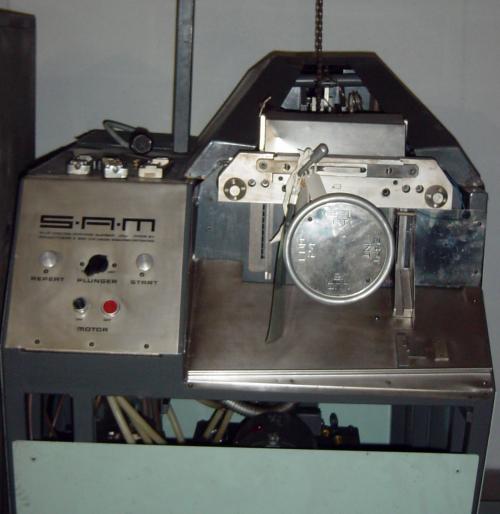
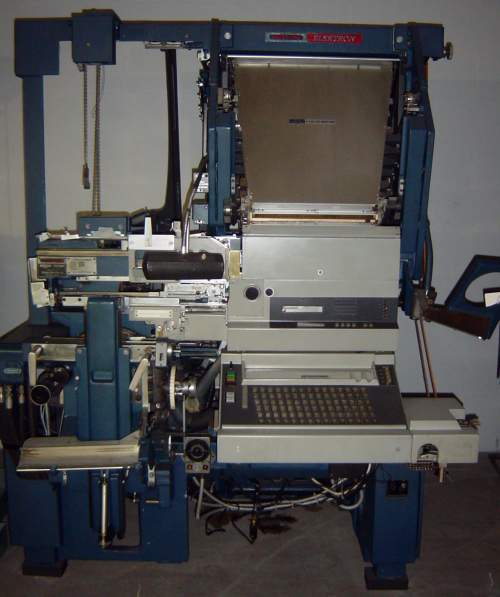
Whittaker S.A.M.

MANUFACTURED in 1966, Serial No. 567.

S.A.M stood for ‘Sets All Matrices.’ It was a hot-metal linecaster made by M.H. Whittaker & Son.

This would then be cast in the machine. S.A.M. could use matrices from Ludlow, Linotype, Intertype and Nebitype companies. Read the Full Article . . .

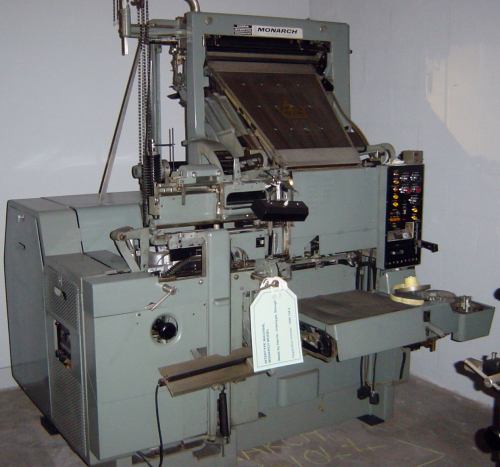
Intertype Monarch

MANUFACTURED in 1962, Serial No. 34515.

The Intertype Monarch was designed without a manual keyboard. It relied totally on Teletypesetting (TTS) for setting type, using instructions from perforated tape.

It had an output of 14 lines per minute. A suction manifold held the matrices to the delivery belt as they were delivered at high speed to the assembler. Read the Full Article . . .

Linotype Elektron

MANUFACTURED in 1962, Serial No. 20050.

On its introduction in 1962, the Electron was said to be the fastest linecaster in the world.

It used Teletypesetting to automatically select matrices through a keyboard operated via perforated tape. Read the Full Article . . .