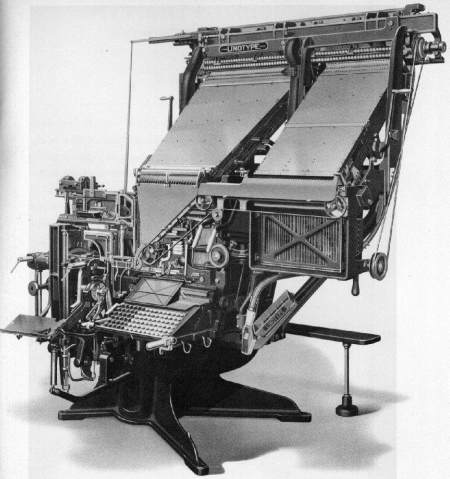
THE ADDITION of two 34-channel extra wide auxiliary magazines makes a Model 26 of the 25.
Matrices from these two magazines can be freely mixed with each other and with those from either of the two main magazines.
Yesterday’s Technology . . . Today!
THE ADDITION of two 34-channel extra wide auxiliary magazines makes a Model 26 of the 25.
Matrices from these two magazines can be freely mixed with each other and with those from either of the two main magazines.
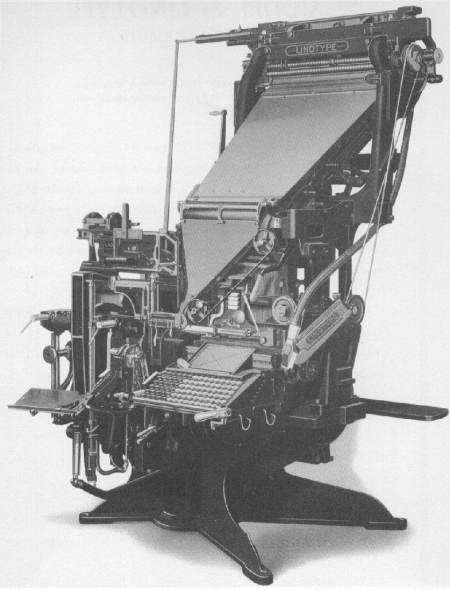
THE ADVANTAGES of multiple distribution are not confined to work on which it is desired to mix matrices from various magazines.
Multiple distribution means that any character in the machine is available at once; that you can shift from one magazine to the other or set a correction line from either, without even waiting for the last line to distribute.
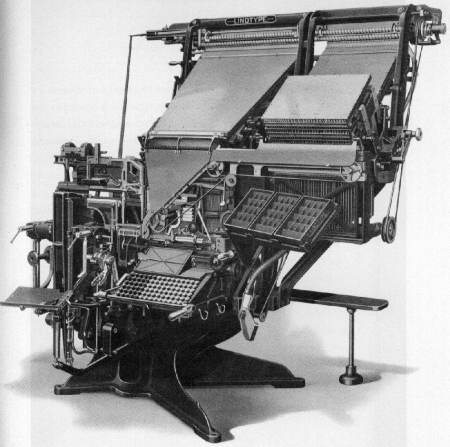
THIS MACHINE is a Model 8 plus the wide auxiliary magazines of 34 channels.
The auxiliary features of the Linotype gives the machine a considerably wider range of usefulness: each magazine will accommodate a full alphabet of characters and figures of any size up to and including extended 36 point, and medium condensed faces up to 60 point.

FOR MIXED composition involving a large number of faces, Model 9 is in a class by itself.
Its four magazines give the operator a range of eight complete faces in four sizes, all immediately available.
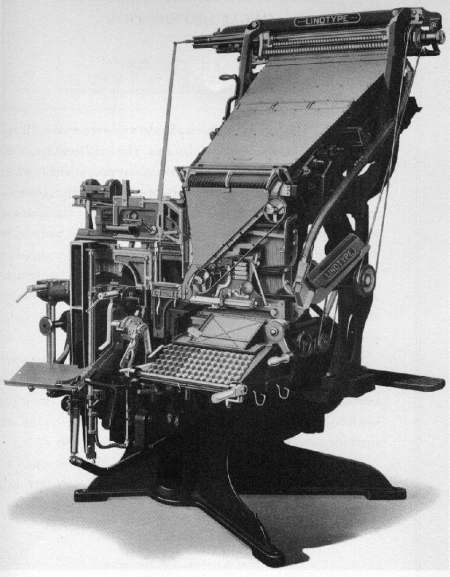
EQUIPPED with either one, two or three magazines, the Model 8 is a popular machine for general composition.
When originally equipped as a single-magazine machine it can be easily converted into a two- or three-magazine machine by the addition of the necessary parts.
Illustrations and machine descriptions of Models 8 to 26 are from a pamphlet called “Linotype Flexibility” published by the Mergenthaler Linotype Company in 1930. Models 28 to 32 from “Linotype Machine Principles” published in 1940.
Linotype fan? Don’t miss the Linotype Chat section of the Metal Type Forum.
METAL TYPE is the place for printers, typesetters and newspaper workers, who fondly remember those letterpress days, to come and reminisce.
The site originally concentrated on the ingenious Linotype mechanical typesetting machine invented by Ottmar Mergenthaler in 1884.

The model 6 was specially designed for the production of work requiring a variety of type faces mixed in one and the same line, such as catalogues, encyclopaedias, dictionaries, etc.
It is equipped with four main magazines and two distributors.
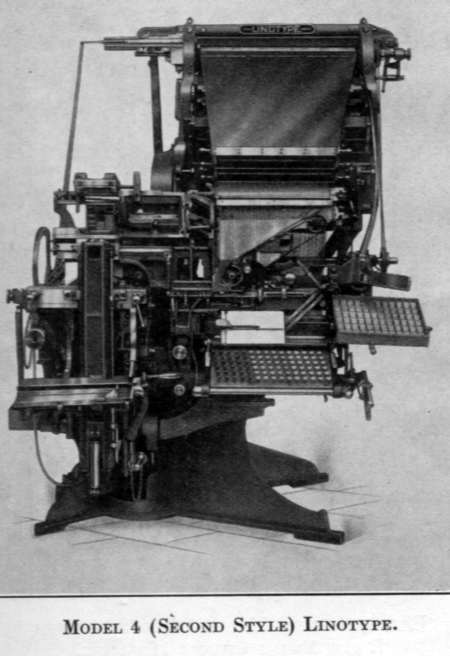
The new Model 4 is the standard three-magazine machine, and is so constructed that a side display section can be added at any time.
It is fitted with all the labour-saving devices which have been developed to date, with the result that the machine provides the most perfect and economical composing equipment within its capacity.
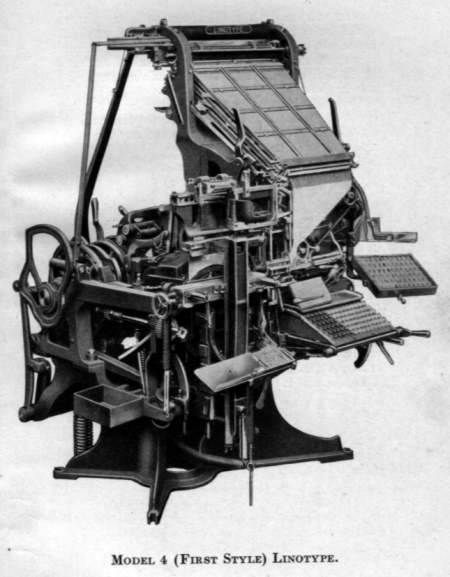
This model increased the capacity of the Linotype machine, enabled the operator to effect a quick change from one magazine to another, and from one mould to another, without getting off his chair, and provided a composing machine suitable for general jobbing as well as the newspaper printer.
With three magazines in position, each charged with double-letter matrices, and with the necessary moulds in the mould wheel, this model was capable of turning out work of varied character at the highest possible speed.